

Behold a Threshold
What means these in-betweens?
I wrote before about interstitial spaces called edge realms, spaces in between accepted categories or genres. In her book When Plants Dream, Sophia Rokhlin describes them as “thresholds of potential and fecundity.”1 An edge realm is a wilderness, a mutant space ripe for new forms, and they’re everywhere in our hi-fi, wi-fi world. In his 2010 book Acoustic Territories, Brandon LaBelle notes, “The wired-up walker enacts a sort of ghosting of the sidewalk—we may never know what sonic matter is floating through the ear of the iPod user, whose step occupies the vague threshold between zombism and activism.”2
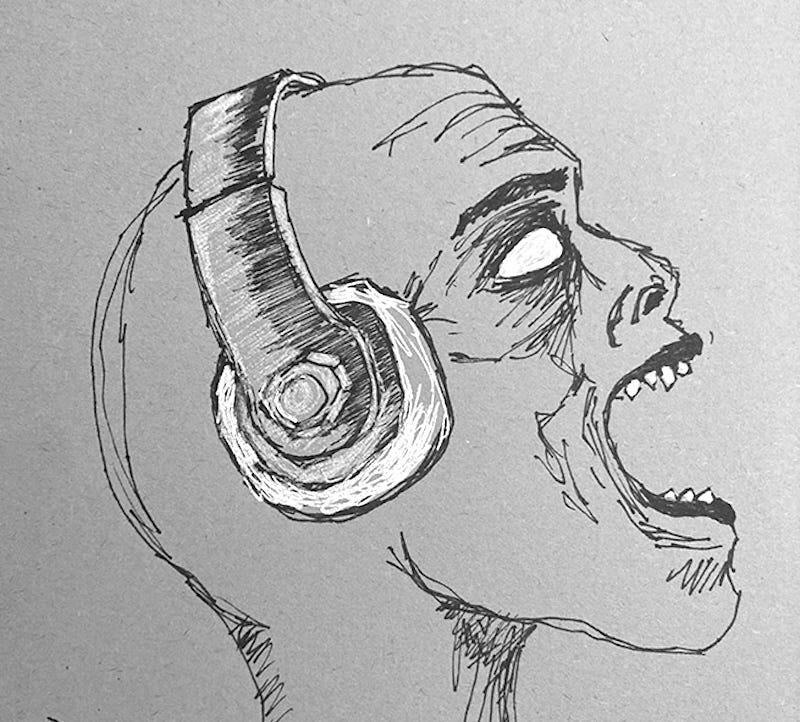
The transitional periods have all the properties of the threshold, the boundary between two spaces, where the antagonistic principles confront one another, and the world is reversed. . . . The rites associated with these moments also obey the principle of maximization of magical profit. —Pierre Bourdieu, The Logic of Practice
The mental space just before we feel oriented and something feels familiar is the discernment of difference, a threshold of perception. Gérard Genette calls the textual peripheries of books—forewords, prefaces, and so on—“paratexts”: “More than a boundary or a sealed barrier,” he writes of such introductory material, “the paratext is, rather, a threshold, or—a word Borges used apropos of a preface—a ‘vestibule’ that offers the world at large the possibility of either stepping inside or turning back. It is an ‘undefined zone’ between the inside and the outside.”3
A beginning is a bifurcation, a deviation that leads off from the current path. Everything starts with a choice between one direction or another. A decision regarding which way to go marks the beginning of possibility while foreclosing another. One possibility is sacrificed so that another may be pursued. The first steps beyond that point take you into alien territory.
In the chapter on sidewalks from her classic book, The Death and Life of Great American Cities (Random House, 1961), Jane Jacobs wrote,
When people say that a city, or a part of it, is dangerous or is a jungle what they mean primarily is that they do not feel safe on the sidewalks. But sidewalks and those who use them are not passive beneficiaries of safety or helpless victims of danger. Sidewalks, their bordering uses, and their users, are active participants in the drama of civilization versus barbarism in cities. To keep the city safe is a fundamental task of a city’s streets and its sidewalks.4
Between your ears, between destinations, thresholds abound. LaBelle adds, “The sidewalk is a threshold between an interior and an exterior, between different sets of rhythms that come to orchestrate the dynamic passing of exchange each individual body instigates and remains susceptible to.”5 The jostling of physical bodies on their way somewhere else, a mix of minds that wouldn’t otherwise meet is only possible in these unattended spaces. Such serendipity is analog.
So we might suggest that the apparent vacuity of the Walkman opens up the prospect of a passage in which we might discover . . . those other cities that exist inside the city. There we move along invisible grids where emotional energies and the imaginary flow, and where the continual slippage of sense maintains the promise of meaning. —Iain Chambers, Migrancy, Culture, Identity
There is a threshold within all of us, a point past which we become a recognizable self, an entity capable of creation. In his 2011 BAFTA screenwriters’ lecture, the luminary of the liminal Charlie Kaufman confesses that a large part of his work is just him trying to get us to like him, what he describes as “an ancient pattern of time usage”:
This pattern of time usage paints over an ancient wound, and paints it with bright colors. It’s a sleight of hand, a distraction, so to attempt to change the pattern let me expose the wound. I now step into this area blindly, I do not know what the wound is, I do know that it is old. I do know that it is a hole in my being. I do know it is tender. I do believe that it is unknowable, or at least unable to be articulated.
The wound is his threshold. It is where his being becomes the thing we call Charlie Kaufman, and we all have one. He continues,
I do believe you have a wound too. I do believe it is both specific to you and common to everyone. I do believe it is the thing about you that must be hidden and protected, it is the thing that must be tap danced over five shows a day, it is the thing that won’t be interesting to other people if revealed. It is the thing that makes you weak and pathetic. It is the thing that truly, truly, truly makes loving you impossible. It is your secret, even from yourself. But it is the thing that wants to live.
It is the thing from which your art, your painting, your dance, your composition, your philosophical treatise, your screenplay is born.
What is my point of threshold? What does it mean to dance on a public stage? Everything is getting vague. But just because I am constantly taking into account that I am overcoming a threshold, is this a cartographic initiative, an attempt at localizing myself within an environment? Or am I realizing that I am an environment as such?
—Min Tanaka, “Body-Assemblage”
A lot of the thresholds inherent in our selves and in our world are unknowable before we confront them. They lead us into the interstitial, the liminal, the edge realms, the in-betweens of existence. The place where all real discovery and real revelation happens.
Messing in the dark and walking all alone
Alone in the streets I know just where I'm going
Chilled to the bone, chilled to the bone
Hot wired heat all the way home
—The Jesus and Mary Chain, “Sidewalking”
Further Reading:
Weak Ties Gone Wild

One of the since-faded early concerns of the internet was “information overload.” The worry was that given the onset of abundant connectivity and content, we were being inundated with so much information that we’d never be able to process it all. Now we limit the flow in our feeds and find just what we need. The real danger of filter bubbles and echo ch…
Some of this jumbley mess is from the beginning of my book The Medium Picture. Some of it is just my thinking aloud as usual.
Regardless, thank you for reading in between,
-royc.
http://roychristopher.com
Sophia Rokhlin, When Plants Dream, London: Watkins Media, 2021, xi.
Brandon LaBelle, Acoustic Territories: Sound Culture and Everyday Life, NewYork: Bloomsbury Academic, 2010, 98.
Gérard Genette, Paratexts: Thresholds of Interpretation, Cambridge, UK: Cambridge University Press, 1997, 1-2.
Jane Jacobs, The Death and Life of Great American Cities, New York: Random House, 2961, 29-30.
LaBelle, 2010, 88.